Business Internet Circuit Acceptance: Test More Than a Speed Result
A practical business internet acceptance checklist covering carrier handoffs, safe wired testing, upload and download evidence, application checks, and cutover documentation.
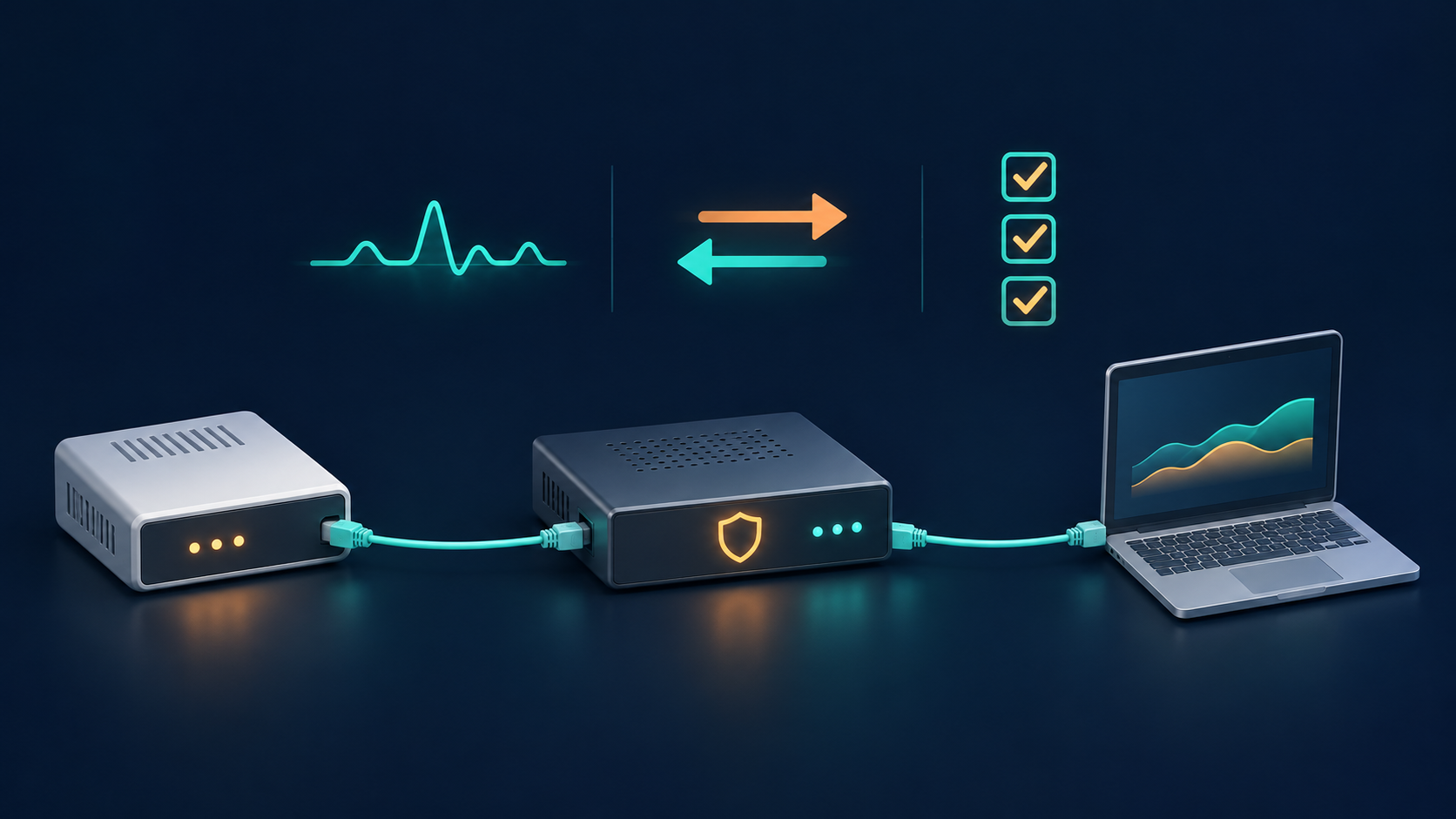
A new internet circuit can produce an impressive speed-test screenshot and still fail the business handoff. Before moving employees, cloud applications, and remote operations onto it, require evidence of what was delivered, where it was tested, and which business workflows actually worked. Do not make the cutover decision from one download number.
For Southern California offices, warehouses, and commercial properties, the installation may involve a carrier, landlord, cabling contractor, firewall administrator, and managed IT provider. The acceptance process below is a recommended project-control workflow for coordinating those responsibilities. It is not a customer incident report, a universal service-level agreement, or a claim that an ordinary internet subscription guarantees performance to every destination.
Separate the provider service from the user experience
RFC 6349 describes TCP throughput testing as an addition to network-layer measurements, with a primary focus on managed business-class IP networks. It explicitly cautions that provisioning the access portion to a specified bandwidth does not guarantee end-to-end performance.[1] Use that distinction when setting expectations: the provider handoff, the path through your firewall, and a transaction with a cloud application are separate acceptance questions.
Ask the carrier to identify the contracted measurement points and test method. Then define your own operational acceptance checks with the IT administrator. A successful application test does not establish that every contractual metric was met, and a carrier turn-up report does not replace a business workflow demonstration.
1. Define the handoff before the installation appointment
Put the intended service and responsibilities into a short acceptance plan. Request the actual service order and applicable service-level terms rather than interpreting a marketing description as the contract.
- Service identity: record the provider, circuit identifier, service address, installation location, support contact, and authorized customer representative.
- Service commitment: confirm the ordered upload and download rates, any committed-rate terms, and the scope and exclusions of any performance agreement. Do not assume the product is symmetric or dedicated.
- Physical boundary: identify the provider equipment, exact handoff port, interface type, required optics or patch leads, and the party responsible for extending service to the network closet.
- Logical boundary: request the applicable address assignment, routing or authentication details, VLAN requirements, supported MTU information, and provider/customer equipment operating mode.
- Operational ownership: assign responsibility for provider equipment power, rack space, patching, firewall configuration, testing, escalation, and cutover approval.
For a multi-tenant property, confirm access to the carrier room, riser pathway, and customer suite before the appointment. Resolve the demarcation extension scope in writing. Avoid a handoff where the carrier has completed its work but no one has accepted responsibility for the remaining connection.
2. Inspect the physical installation and the production path
Before traffic testing, have the responsible parties identify and label the provider handoff and its connection to the business firewall. Record equipment identifiers, port assignments, negotiated interface settings, and relevant link-error counters. Compare the installation with the agreed design and manufacturer requirements.
Verify that the test client and its wired adapter are appropriate for the ordered service. RFC 6349 identifies host hardware capability as a necessary consideration before throughput testing and discusses dedicated test instruments for demanding line rates.[1] Do not treat a limitation of the measurement device as proof of a carrier fault.
Keep diagnostic bypass tests separate from acceptance
Use the intended firewall and ordinary security configuration for the operational baseline. If a provider requests a direct handoff test, have the authorized administrator establish a protected, temporary arrangement and document precisely what was bypassed. Never attach an unprotected employee workstation to a public handoff simply to obtain a better result.
Record the firewall services enabled during each test. If a diagnostic run changes inspection settings or removes an intermediate device, label it as a different configuration. Restore and verify the approved production state afterward. A faster bypass result is diagnostic evidence, not acceptance of the deployed network.
3. Approve the test method before generating traffic
RFC 6815 states that RFC 2544 benchmarking methods must not be used on production networks; it explains that overload traffic can harm user traffic and produce misleading results outside an isolated test environment.[2] Do not run a laboratory overload benchmark against a live shared service because a test tool offers an RFC 2544 button.
Have the provider and IT administrator agree on a method appropriate to the service and network under test. RFC 6349 also warns that throughput testing may require cooperation between the customer and provider and identifies denial-of-service concerns associated with test traffic.[1] An installation window does not by itself make a shared provider network an isolated laboratory.
- Authorization: name the test endpoints and obtain permission to generate the proposed traffic at both ends.
- Impact limits: define approved load, duration, timing, and stop conditions with the provider and business owner.
- Protection: use non-sensitive sample data and approved tools; do not expose an unrestricted test server to the internet.
- Abort procedure: stop if agreed limits are exceeded or production service is affected, and identify who can restore normal operation.
- Measurement scope: state whether the result describes the carrier service, the office network path, or a particular external destination.
4. Capture repeatable evidence, not the best screenshot
Define pass/fail criteria before testing. Use the service agreement for carrier commitments and separately approved requirements for business operations. Avoid inventing a universal acceptable latency, packet-loss allowance, or percentage of advertised speed.
- Establish a wired baseline: record the client, adapter, interface speed, cabling path, firewall configuration, tool version, destination, timestamp, and time zone. Note concurrent business traffic.
- Test each direction: measure upload and download using the approved method. Identify whether directions were tested separately or together and preserve the result of each run.
- Record traffic characteristics: capture the test duration, connection count, transport, and relevant tool settings. Do not compare unlike test profiles as though only the circuit changed.
- Observe responsiveness: where supported by the approved tools, record baseline round-trip time and its behavior during the agreed load. Document the endpoint and measurement method.
- Review errors: compare available interface counters, loss observations, and retransmission information before and after testing. Do not diagnose a specific fault from one unexplained number.
- Repeat under documented conditions: retain the agreed set of runs, including poor results. After a correction, repeat the affected test and identify the configuration change.
RFC 6349 identifies bottleneck bandwidth, round-trip time, socket buffers, receive windows, and path MTU as factors in TCP performance; it also distinguishes single-connection and multiple-connection testing.[1] A low result should prompt structured investigation of the complete measured path, not an immediate assumption that the carrier or the firewall is at fault.
The same framework includes buffer delay, which compares round-trip time during a transfer with its baseline value.[1] Include responsiveness evidence alongside throughput rather than accepting a high transfer rate as a complete description of service quality.
5. Demonstrate the business workflows through the final configuration
Choose representative activities with the people responsible for them. Test a cloud application sign-in and normal transaction, an approved upload, and the remote-access workflow actually used by the business. Include voice or video workflows if they are in scope. Use controlled accounts and non-sensitive test content.
If the project depends on a specific public address, external allowlist, site-to-site connection, or inbound service, have the authorized administrator verify that exact dependency. Do not create broad inbound firewall rules or expose surveillance equipment to make a test pass. Document unavailable features or service limitations and route them to the decision maker.
Keep these results distinct from contractual service testing. Record the observed user outcome and application destination without claiming that one successful transaction establishes performance for every cloud provider. Any untested critical workflow should remain an explicit exception, not disappear from the handoff report.
6. Close out the circuit before closing the ticket
Require a compact evidence package that another technician can use without repeating the installation discovery:
- The service order, circuit identifier, applicable support and escalation contacts, and agreed acceptance criteria.
- A labeled handoff photograph or diagram, equipment and port records, and the documented provider/customer responsibility boundary.
- The approved production configuration reference, addressing and routing documentation, and controlled configuration backup location.
- Raw test reports, test settings, timestamps, business workflow results, and any provider turn-up report with its measurement scope.
- Failed tests, corrective actions, retests, unresolved limitations, named owners, and explicit acceptance decisions.
- The cutover sequence, rollback criteria, support coverage, and authorization for retiring the previous service.
Store passwords and authentication secrets in an approved credential repository, not in photographs or an ordinary acceptance report. Do not cancel an existing circuit solely because the new handoff has link lights; require the agreed operational checks and a documented business decision first.
Accept the circuit with a defined boundary, repeatable evidence, and a working business path—not a single speed result.
How SkaiCloud Network helps
SkaiCloud Network can help coordinate network infrastructure, structured cabling, managed IT requirements, and documented service handoffs. Scope the work so the carrier, property representative, and IT administrator each know which installation, configuration, and acceptance tasks they own.
Before your next circuit installation or office move, request a written handoff and testing plan. Discuss business internet handoff and network readiness planning with SkaiCloud Network before scheduling the production cutover. The objective is not the most impressive screenshot; it is a connection whose delivered scope and operational readiness are documented.
Featured image: original conceptual illustration of a provider handoff, firewall, and wired test client; not a customer installation, product dashboard, or complete network design.