Fiber Optic Cable Repair: Define the Fault and Restoration Scope Before Splicing
Scope commercial fiber repair around ownership, optical fault evidence, authorized corrections, and documented service restoration—not an assumed need to splice.
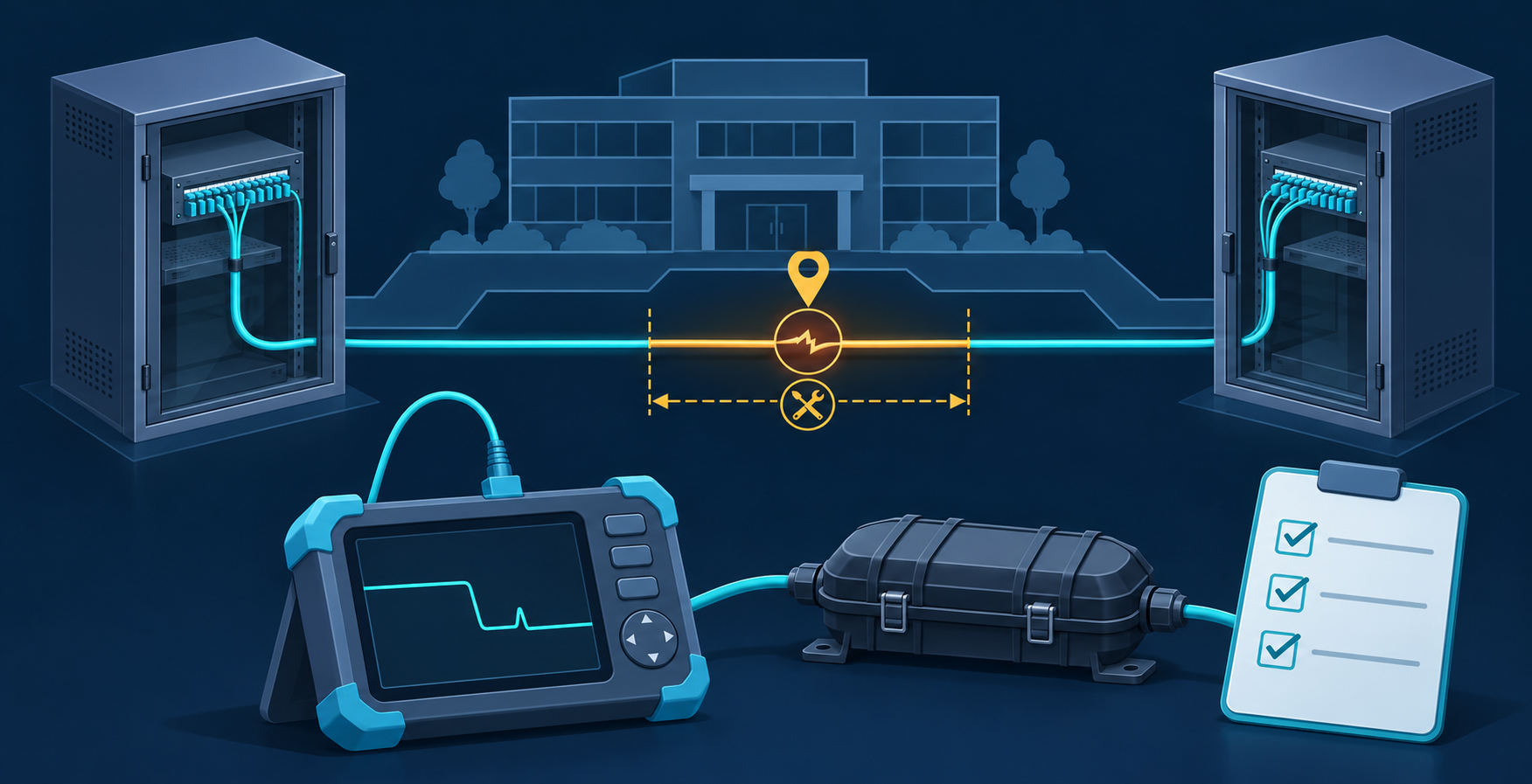
A dark fiber uplink can stop work across an office or warehouse, but an outage is not automatic proof that the installed cable needs to be cut and spliced. Before authorizing fiber optic cable repair, establish who owns the affected segment, what evidence identifies the fault, and how the repaired connection will be returned to service.
For commercial properties in Los Angeles, Orange County, the Inland Empire, and San Diego, this recommended repair-scoping workflow separates investigation, authorized physical work, and operational restoration. It concerns an existing link that has failed or become unreliable—not acceptance of a new backbone or installation of a new carrier extension.
Confirm the Repair Boundary Before Dispatch
Start with the two endpoints, the affected business workflow, and the party responsible for each part of the connection. Distinguish a customer-owned building backbone from a carrier circuit or shared building infrastructure. Ask the carrier, property manager, and IT administrator to confirm the boundary where it is unclear. An accessible panel is not permission to alter its contents.
- Identify the service: record the circuit or internal link identifier, endpoint rooms, panels, ports, and known strand assignments.
- Confirm authority: name who may disconnect equipment, open an enclosure, approve a splice, or authorize cable replacement.
- Arrange access: confirm escorts, shared-room permissions, work hours, lifts, and access to both ends before scheduling intrusive tests.
- Preserve evidence: collect the failure time, relevant alarms, recent work nearby, photographs taken with permission, and original test files.
- Define spending authority: separate the initial diagnostic visit from repairs requiring approval. Do not make an unrestricted replacement allowance the default response.
Ask the contractor to state what the first visit will deliver if the fault cannot be reproduced: an endpoint map, observations, completed tests, unresolved questions, and the next proposed action. Do not accept a guaranteed restoration time without a confirmed fault, access plan, and available materials.
Separate an Optical Path Problem From an Equipment Problem
Have the IT administrator capture relevant port status, alarms, and available optical diagnostics before rebooting or replacing equipment. Record transceiver models and the intended interface arrangement at both ends. Treat device-reported readings as observations to interpret against the applicable equipment specifications, not as an automatic diagnosis of damaged cable.
Ask the technical team to distinguish three questions: is the intended transmitter operating, how much optical power reaches the receiving end, and what loss does the passive cable path introduce? FOA treats transmitter/receiver power measurements and cable-plant insertion-loss testing as distinct checks.[16] A repair proposal should identify which question its evidence actually answers.
Use controlled substitutions only with compatible components and an approved interruption plan. Record the original arrangement and each change. If replacing several components restores service, document that sequence without claiming that one untested component was definitively the cause.
Make Safety an Explicit Part of the Work Order
Do not look into a connector or broken fiber to check whether it is active. FOA advises never looking into a fiber end and testing for optical power before working on a fiber.[24] Require trained personnel, an appropriate power-check and isolation procedure, and instruments suitable for the actual system. A missing visible glow is not a clearance to inspect or handle an unknown optical path.
Keep unauthorized staff away from open termination work. Require the contractor to control the work area, manage fiber scraps, and follow the relevant equipment and site safety procedures. Shared telecom rooms, roof areas, vaults, and underground pathways need their own access and safety planning; an office repair authorization does not automatically cover those environments.
Request Fault Evidence Before Approving a Splice
Ask for a finding tied to an identified strand and endpoint. Request connector inspection and any appropriate cleaning under the approved safe procedure before authorizing destructive work. Require the technician to record what was observed, what changed, and the result of the subsequent check. Do not turn a suspected contamination issue into an unexplained cable replacement.
An optical time-domain reflectometer, or OTDR, can help find faults and measure length and splice loss; FOA also describes comparing a current trace with the original installation trace during troubleshooting.[17] Request the original baseline where available and ask the reviewer to explain the event supporting the proposed repair.
Use a reported optical distance as an investigation lead, not as an excavation instruction. Ask the contractor to reconcile it with the actual route, slack storage, panels, and known splice locations before identifying a physical work area. Record uncertainty where the route is undocumented. Never approve opening a wall, cutting a cable, or disturbing another tenant's service on an unexplained distance reading alone.
Where OTDR work is proposed, have the specialist identify a suitable setup for the link and the measurements required. FOA explains that a launch cable helps evaluate the near-end connection and a receive cable allows measurement of the far-end connector.[17] Ask which connections the saved trace actually includes, rather than assuming every automatic report covers the complete path.
Approve a Restoration Method With a Permanent End State
Require the proposal to distinguish patch-cord replacement, connector work, an authorized spare-strand transfer, splice repair, and replacement of a damaged section. Ask why the proposed approach fits the documented fault and existing installation. The scope should identify compatible materials, affected strands, required slack, enclosure work, protection, labeling, and any pathway restoration.
If using a spare strand, verify its identity and suitability first and update the strand assignment. Treat it as a configuration and documentation change, not an invisible workaround. If a temporary restoration is necessary, identify its owner, physical protection, remaining risks, and the planned permanent correction. Do not leave temporary work with no review date or removal plan.
For inaccessible or damaged pathways, obtain a separate plan and approvals from the responsible parties. Do not assume a fiber repair quote includes construction, excavation, penetrations, or restoration by other trades.
Verify the Repaired Path and the Restored Service Separately
Do not close the ticket on a splice-machine estimate or one screenshot. FOA identifies continuity, polarity, and end-to-end insertion loss as cable-plant checks, and distinguishes OTDR fault analysis from direct insertion-loss measurement using a source and power meter.[16][17] Agree on the applicable post-repair tests and acceptance criteria before the repair begins.
- Physical-link evidence: retain the agreed inspection and test records under the repaired link identifier, with the test setup, reference method, wavelengths, and criteria appropriate to the scope.
- Change record: identify the repair location, replaced components, splice or strand changes, and final patching. Preserve before-and-after records where available.
- Network restoration: have the authorized IT team reconnect the intended service and check the relevant interfaces and network path.
- Business verification: repeat an agreed application workflow from the affected location, rather than assuming an illuminated link indicator proves usable service.
- Observation and ownership: record the monitoring period, any remaining intermittent symptoms, and who receives a recurrence report.
If no fault was reproduced, say so. Separate confirmed defects, corrective actions, and unresolved hypotheses. A useful report can describe restored service and remaining uncertainty without inventing a root cause.
Prepare a Useful Fiber Repair Request
SkaiCloud Network can help review the low-voltage scope and coordinate physical-link investigation with network support. Before requesting work, gather endpoint identifiers, authorized photographs, existing strand schedules, original test files, equipment details, and the business impact. Ask for a scope that names the diagnostic boundary, repair approval process, and restoration evidence.
For an existing commercial link, request a fiber troubleshooting and repair scope review with your endpoint details and incident record. Establish access and authority first, approve the correction supported by evidence, and retain a record the next technician can use.
Featured image: original AI-generated conceptual illustration of fiber fault investigation and repair documentation; not a client photograph, measured OTDR result, or construction diagram.