Beyond the Cable: The Non-Negotiable Rules of Network Documentation & Compliance
Why detailed network mapping, proper asset inventory, and adherence to industry standards are essential for reducing operational risk and streamlining IT support.
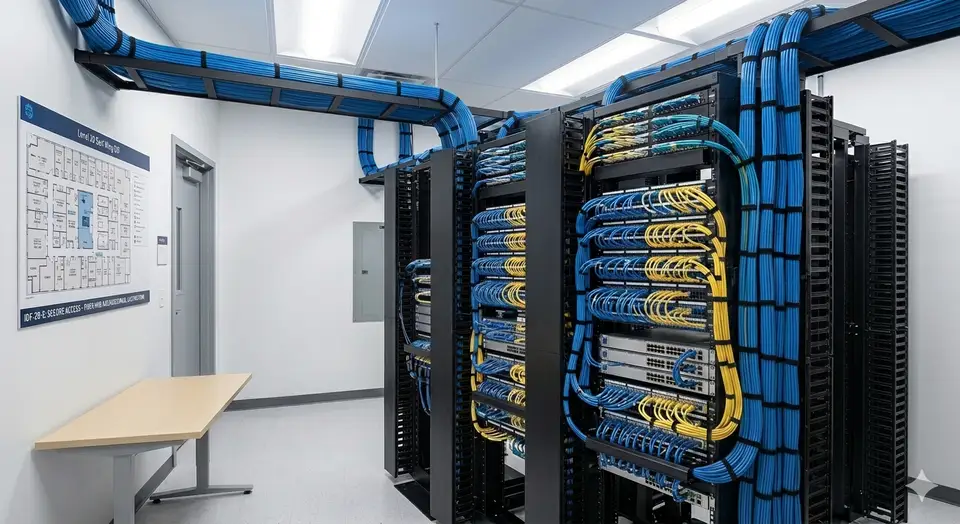
When a network is installed perfectly—with pristine cabling and robust hardware—the project isn't finished until the documentation is complete. Many organizations treat network diagrams and asset inventories as an administrative burden to be completed at the very end. However, in reality, comprehensive documentation is not just paperwork; it is the single most vital piece of operational intelligence that minimizes Mean Time To Resolution (MTTR) during a crisis.
Why Documentation Is Not Just Paperwork
In an emergency—whether it's a critical data leak, an unexpected outage, or a sudden compliance audit—time is the most expensive commodity. Without accurate network diagrams showing how devices connect, which VLANs are active, and where key assets like firewalls reside, your IT team must spend hours simply figuring out 'what is connected to what.' This delay can cost thousands of dollars per minute.
The Three Pillars of a Compliant Network
- Network Diagrams (Physical & Logical): A diagram must show both the physical run (cable paths, racks) and the logical flow (VLANs, subnet masks, IP assignments). This allows engineers to visualize data traffic flows, not just copper wires.
- Asset Inventory: Every piece of hardware—from switches and patch panels to end-user devices—must be logged with its serial number, purchase date, location, assigned owner, and current firmware version.
- SOPs & Runbooks: Standard Operating Procedures (SOPs) must detail how to perform common tasks: how to provision a new user, how to patch an endpoint, and the step-by-step process for escalating network failure.
How SkaiCloud Enforces Documentation Excellence
SkaiCloud integrates documentation into our core process. We don't wait until the end; we make it part of every phase:
- Assessment: We begin with an audit, mapping out your precise operational needs, building code constraints, and current infrastructure limitations.
- Design & Simulation: We engineer a network topology that isn't just functional today, but scalable for the next five years—incorporating future growth for AI or IoT devices.
- Closeout: Our final deliverables include a structured compliance packet containing all labeled schematics, asset manifests (in CMDB-friendly formats), and tested SOPs ready for your internal team to adopt immediately.
Best Practices: Making Documentation Living
Documentation should never be static. We advise implementing 'documentation checkpoints' into your workflow: every time a major change occurs (a new firewall, a VLAN addition), the documentation must be updated and approved by a designated technical owner before the change is marked complete.
Treating your documentation like active code—version controlled, peer-reviewed, and audited—is the difference between reactive firefighting and proactive IT governance.
The Payoff
A well-documented network translates directly into reduced operational risk, faster recovery times, and easier auditing. It turns a complex infrastructure puzzle into a manageable, understandable system.
Let's build your compliance roadmap. Contact SkaiCloud for an Audit & Documentation Strategy session today.