Access Control for a Commercial Building: Decide These Six Things Before You Ask for Quotes
Three bids for the same building can land thousands apart because nobody settled the basics first. Six decisions to make before you ask anyone for a price.
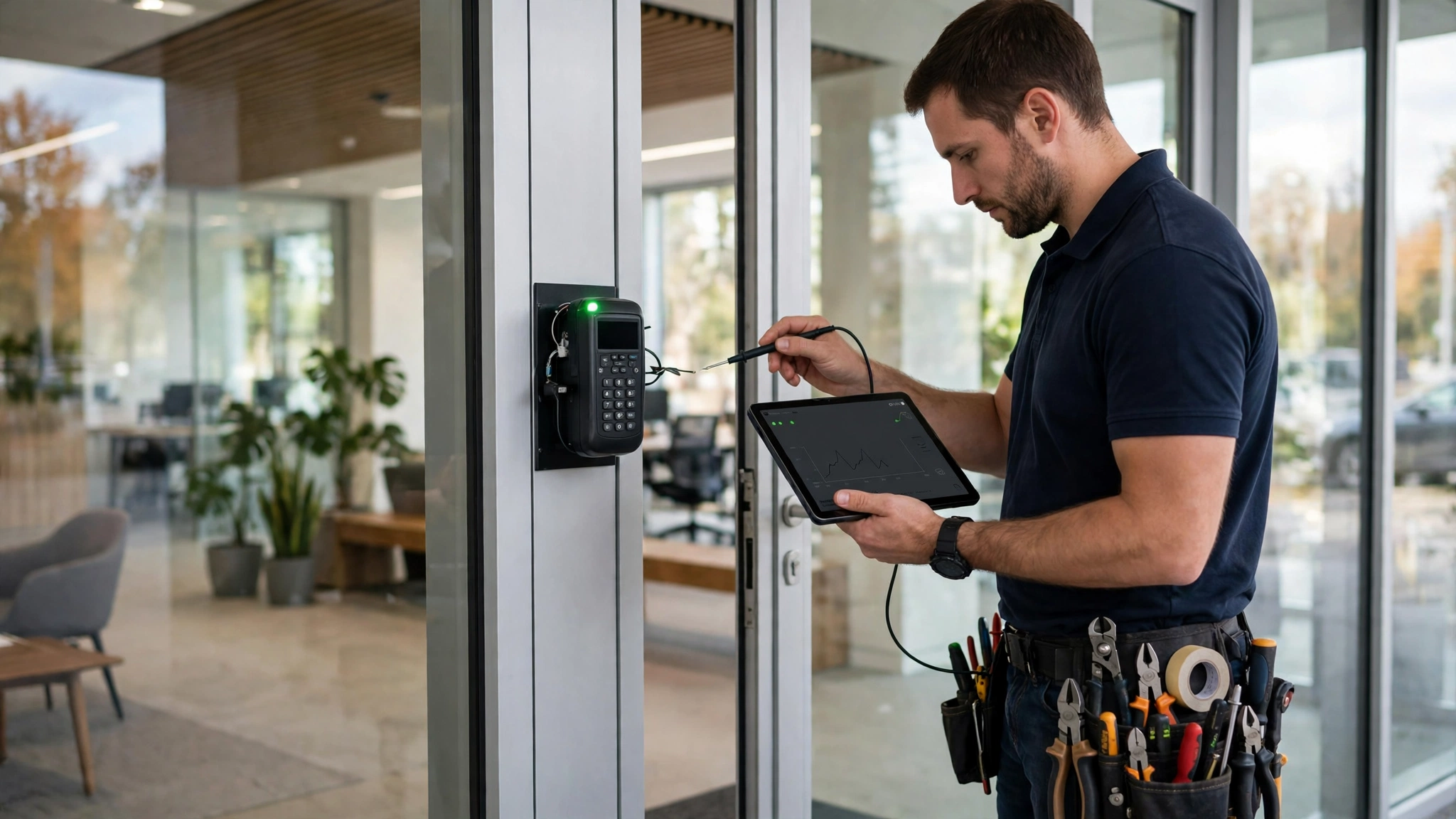
Most access control quotes start with a phone call that goes like this: "We need badges for the front door, and maybe the back." Three contractors walk the building, three very different numbers come back, and nobody can tell which one is right. The gap is rarely dishonesty. It is that nobody settled the basic decisions before asking for prices, so every bidder filled in the blanks their own way.
We install these systems across Los Angeles and Orange County, and the jobs that go smoothly share one thing. The owner or property manager made six decisions up front. None of them require technical knowledge. All of them change the price.
1. Which doors actually need it
A controlled door is not just a card reader. It is a reader, an electric lock, a door contact, a request-to-exit device, cabling back to the panel, and a share of the panel and power supply. Price it per door and the math gets honest fast. A main entry and a back door might be all a small office needs. The stairwell, the suite door, the server room and the warehouse roll-up are each a real decision, not a default. Walk the building and mark the doors. If a door only needs to stay locked, a key or a keypad lock may do it for a tenth of the cost.
2. What the lock hardware has to be
Three common choices, three different jobs. An electric strike keeps the existing latch and is usually the cleanest retrofit. An electrified lever or panic bar suits storefront and exit doors. A magnetic lock holds hard but comes with rules: it has to release on fire alarm and on a push button, and in many jurisdictions it needs a permit and an inspection. If a quote assumes strikes and your doors need maglocks with the release hardware done right, the change order writes itself. Look at what is on the door today before anyone prices it.
3. Cards, fobs, phones, or codes
Credentials sound like a detail. They run the system every day after we leave. Cards and fobs are cheap and easy to hand out, and just as easy to lose, which is fine if someone in the office can deactivate one in two minutes. Mobile credentials skip the plastic but need every employee's phone in the plan. Shared door codes are the weakest option we see in the field; they spread, they never get changed, and they tell you nothing about who came in. Pick the credential around the person who will actually manage it, not around the brochure.
4. Where the panel lives, and how it stays alive
The control panel needs a home with power and a network connection, usually the same closet as your switches. It also needs battery backup sized for your building. A system that dies the moment the power flickers is a lockout waiting to happen, and doors that fail locked versus fail unlocked is a life safety conversation, not a preference. Ask where the panel goes and what happens on a power outage. A bidder who has thought about it will answer without pausing.
5. Who runs it after handoff
Somebody will add a new hire at 6 p.m. on a Friday. Decide now whether that is your office manager through a cloud login, your IT person, or a call to the installer. Cloud-managed systems make that a two-minute task from a phone. Older panel-and-server setups can strand you waiting on whoever holds the password. Neither is wrong, but the quote should include setting up your admins and training them, in writing, not as a favor later.
6. What it has to talk to
Access control rarely lives alone. The camera over the door is worth twice as much when a badge event pulls up its footage. A visitor intercom, an elevator, a parking gate, an alarm system: each connection is simple when it is planned and painful when it is an afterthought. List the systems you expect to connect, even if the connection itself comes later. Pulling the cable and leaving panel capacity now costs a fraction of opening finished walls later.
What a good quote looks like
It names every door. It prices hardware per door, not as one lump of equipment. It states the credential type and how many are included, where the panel mounts, how long the batteries carry the system, and who gets trained. If a quote is a single number with a logo on it, you do not have a quote. You have a guess with your name on it.
If you are planning a system for a building in Los Angeles or Orange County, we are happy to walk it with you and mark the doors before anyone talks price. That walk is free, and it makes every bid you collect, ours included, easier to compare.