Network Monitoring Alerts: Prove Delivery Before an Outage
A practical acceptance checklist for network monitoring: verify detection, notification delivery, escalation, maintenance suppression, and responder ownership before handoff.
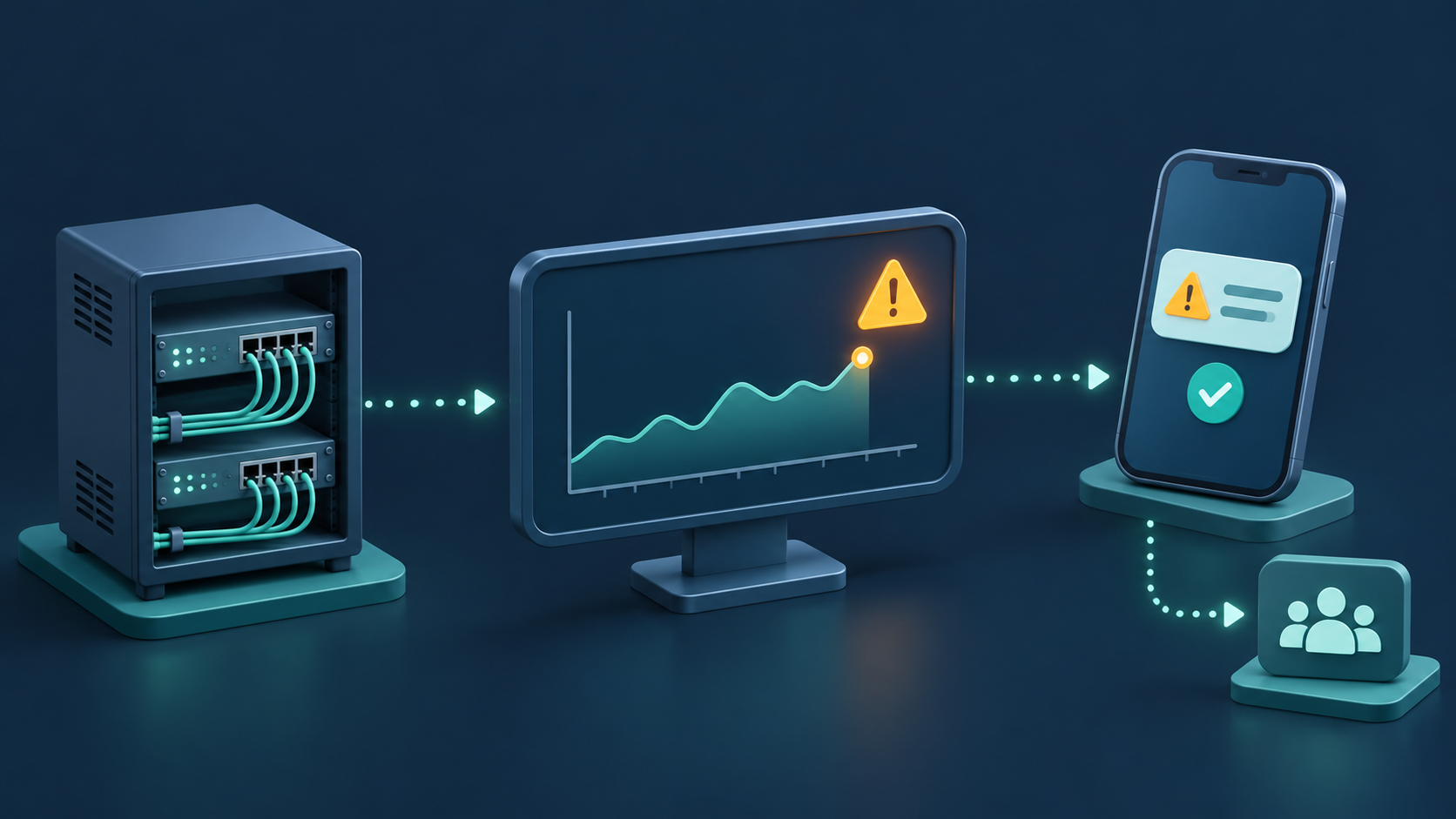
A switch can fail, a dashboard can turn red, and the business can still lose hours because nobody received an actionable alert. Before accepting network monitoring, require evidence that the right person receives the right message, understands the affected service, and knows what to do next. A monitored device is not the same thing as an operational response.
For Southern California offices, warehouses, and commercial properties, the handoff should include notification delivery and ownership—not just a screen full of green indicators. The checklist below proposes practical acceptance controls. It is not a customer incident report, a service-level guarantee, or a claim that every monitoring product has the same features.
Why detection and notification need separate tests
Prometheus documents alerting as two parts: server-side rules send alerts to Alertmanager, which manages those alerts and sends notifications through channels such as email, on-call systems, and chat platforms.[1] That architecture illustrates an important acceptance distinction: detecting a condition and delivering a message are separate checkpoints.
In the same product, Alertmanager groups and routes alerts to receiver integrations and supports silencing and inhibition.[2] Use the documentation for the installed platform to identify its equivalent components. Do not assume a rule that appears active has reached an inbox, a phone, or an assigned responder.
1. Define business impact before choosing alerts
Start with a short monitoring acceptance matrix approved by the business owner and the responsible IT administrator. Organize it around business services rather than an undifferentiated device list. A warehouse receiving workflow, an office phone service, and a remote-access connection may need different responses.
- Service and dependency: identify the workflow, supporting equipment, site, and relevant connection. State whether the check measures a device response, an interface condition, or an actual service transaction.
- Condition: describe what should trigger the alert, what counts as recovery, and which operating periods matter.
- Priority: distinguish urgent service interruption from a condition that can wait for the next staffed review.
- Owner: name the responsible role, primary recipient, backup recipient, and approved coverage hours.
- Action: attach a short first-response procedure and the boundary between observation, authorized remediation, and escalation.
Set detection, delivery, acknowledgment, and escalation objectives explicitly in the project scope. Do not insert an arbitrary universal response time or imply around-the-clock coverage when the contracted service does not include it. Have the business approve any period without a responder.
2. Inspect the full path from device to recipient
Have the administrator map the actual monitoring path: monitored target, collector or agent, monitoring server, notification service, delivery provider, and final recipient. Record where each component runs and who maintains it. Include the network, power, identity, and external-service dependencies relevant to that deployment.
Ask what happens when the monitored site disappears
As a design review exercise, assume the site's internet connection or local monitoring server becomes unavailable. Ask which component can still observe the failure and which path can still deliver a message. If the proposed design depends entirely on the failed location, require a documented limitation or a separately designed external check. Do not label a cloud dashboard independent without tracing how it receives site data.
Review service accounts, API credentials, sending identities, recipient lists, and provider restrictions against the installed system's instructions. Keep secrets in the approved credential repository. The closeout package should identify credential ownership and renewal responsibility without exposing passwords or tokens.
3. Review grouping, suppression, and maintenance behavior
Prometheus describes grouping as combining similar alerts into one notification, inhibition as suppressing notifications when another alert is already firing, and silences as muting matching alerts for a defined time.[2] These are documented product behaviors, not a guarantee that another platform implements them identically.
For your deployment, require the administrator to explain every active maintenance window, suppression rule, dependency rule, and routing exception affecting critical services. Treat those settings as acceptance items rather than hidden implementation details.
- Parent and child failures: decide what the responder should receive when a site connection and several downstream devices are unavailable together.
- Notification content: retain enough information to identify the site, affected service, observed condition, and next action even when messages are grouped.
- Maintenance ownership: record who can suppress alerts, how suppression expires, and how normal monitoring is confirmed afterward.
- Repeated transitions: establish how intermittent conditions will be reviewed. Avoid hiding a recurring fault merely to reduce message volume.
- Routing changes: review former employees, obsolete shared mailboxes, and unmanned destinations before approving the recipient list.
4. Run a controlled end-to-end acceptance test
Use an approved maintenance window, named participants, expected outcomes, stop conditions, and a recovery plan. Do not disconnect production uplinks or disable security systems simply to produce a dramatic notification. Prefer a safe test target or the product's supported test method, and state what the chosen method actually proves.
- Record the baseline: capture target identity, rule configuration, route, maintenance state, expected recipient, and test authorization.
- Exercise detection: create a supported, bounded condition on the approved target. Confirm the monitoring platform records the expected state and timestamp.
- Verify actual delivery: have the intended recipient confirm receipt through the normal delivery channel. Record the message and receipt time; a notification log alone is not the final recipient's confirmation.
- Check usability: ask a responder who did not configure the rule to identify the affected service and approved first action from the message and linked procedure.
- Exercise escalation: where the design includes it, use an authorized test scenario to demonstrate the backup route or on-call escalation. Distinguish an acknowledgment from a resolution.
- Verify recovery: restore the approved target state, confirm the platform clears the condition, and check any configured recovery notification.
- Restore normal operation: remove temporary routes and suppressions, confirm production recipients, and record unresolved exceptions.
Keep timestamps for the observed condition, rule activation, notification dispatch, confirmed receipt, and acknowledgment where available. Identify the clock source and any uncertainty when comparing records. Use the results to evaluate the agreed objectives instead of reporting a single unexplained “alert time.”
Label partial tests honestly
A test email demonstrates only the delivery path exercised. An injected alert may demonstrate routing without proving device detection. A dashboard state change may demonstrate detection without proving notification delivery. Mark each result as passed, failed, or not tested, and retain the evidence for each checkpoint. If a disruptive scenario remains untested, list it as an exception rather than extrapolating a pass.
5. Close out with a response-ready handoff
Require the accepted service matrix, monitored inventory, rule and route references, dependency map, coverage hours, recipient ownership, test evidence, suppression policy, and first-response procedures. Store operational documentation where authorized responders can retrieve it during a site outage, with access appropriate to its sensitivity.
Assign review triggers such as a staff departure, notification-provider change, firewall replacement, site move, new critical application, or changed coverage agreement. Schedule repeat checks according to business risk and the service scope. Do not let a successful installation-day test become permanent evidence for a configuration that has since changed.
Accept monitoring on the response it can initiate, not on the number of devices it can display.
How SkaiCloud Network helps
SkaiCloud Network can help scope network monitoring requirements, document infrastructure dependencies, and coordinate acceptance tests and operational handoffs. Define the boundary between infrastructure installation, monitoring-platform administration, application ownership, and incident response before work begins. Any ongoing response coverage should be stated explicitly in the service agreement.
Before approving the monitoring handoff
Choose one important business service and follow its alert from the original condition to a named responder. Require delivery evidence, a usable first action, a backup route where included, and a documented recovery result. Discuss network monitoring acceptance and operational handoff with SkaiCloud Network before treating a dashboard as an outage-response plan.
Featured image: original conceptual illustration, not a customer installation photograph, live dashboard, or verified incident record.