Ethernet Cable Repair: Isolate the Fault Before Replacing the Run
Scope commercial Ethernet cable repair around controlled fault isolation, approved corrections, saved test results, and a working business connection—not an assumed need to rewire.
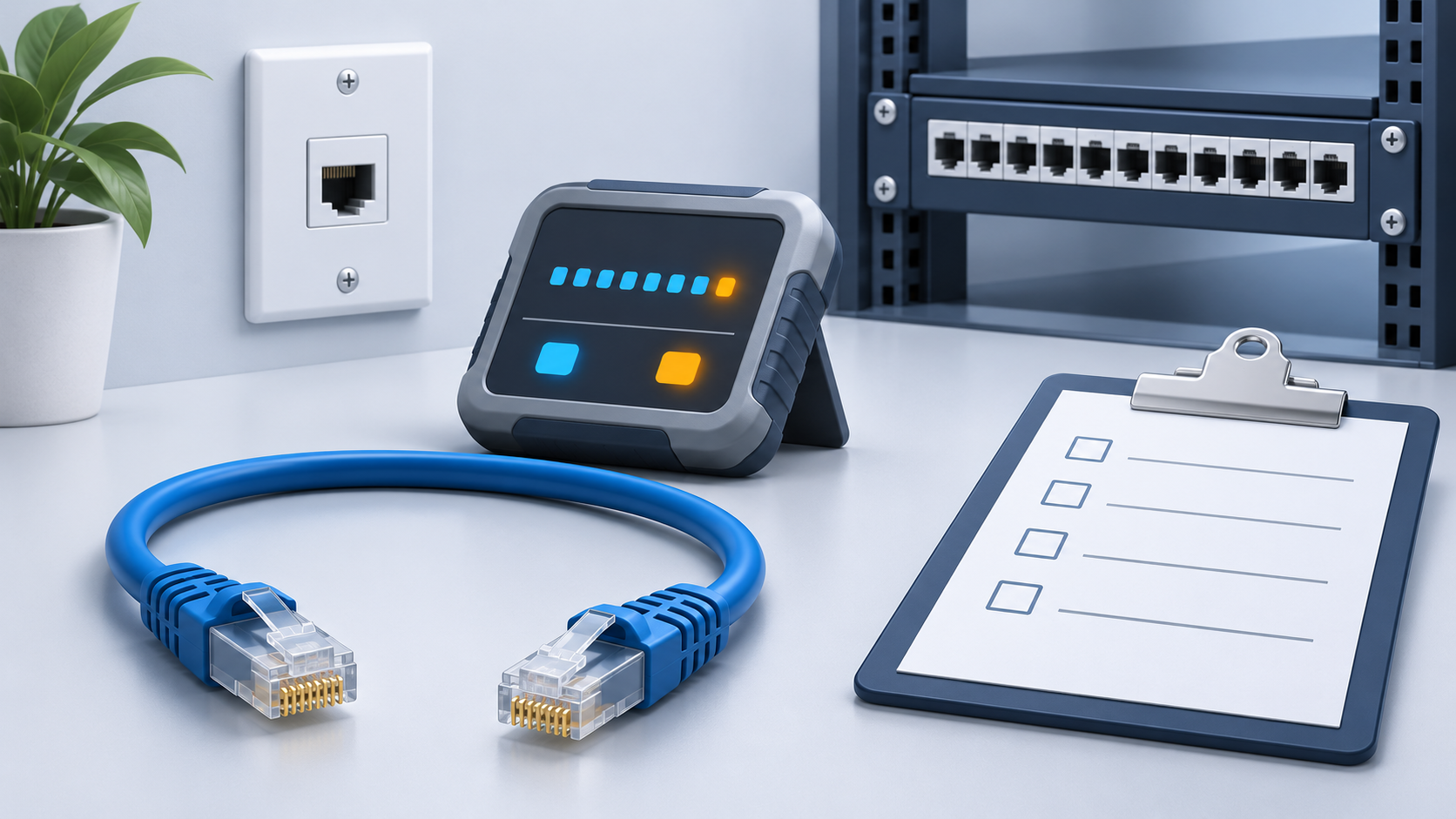
A workstation drops its connection, a desk phone restarts, or an access point goes offline. Someone calls the cable bad. Before approving a replacement run through an occupied ceiling, ask for evidence that separates the patch cords, fixed cabling, switch port, and connected device. Ethernet cable repair should target an identified fault—not become a building rewire based on a symptom.
For businesses in Los Angeles, Orange County, the Inland Empire, and San Diego, the following recommended service workflow helps define a focused commercial cabling repair visit. It addresses an existing connection that has become unreliable, rather than quoting a new installation or accepting an entire new cabling system.
Define the Repair Boundary Before the Visit
Identify the affected outlet, room, connected equipment, and business function. Record whether the failure is constant or intermittent and whether nearby connections remain usable. Preserve any available photographs, cable labels, previous test files, and the time of the last observed failure.
Ask the contractor and IT administrator to agree on the investigation boundary. A cabling contractor may test and repair the physical connection while the IT provider controls switch configuration, network assignments, and application access. Name both owners before work begins. Do not assume that a cable-repair work order authorizes changes to the production network.
- Business impact: identify the affected workflow and who can approve an interruption.
- Access: confirm rack access, suite access, ceiling restrictions, escorts, and landlord permissions where applicable.
- Initial deliverable: request a mapped connection, documented observations, test results, and a recommended correction or next investigation step.
- Repair authority: define which replacements or reterminations are included and when additional approval is required.
- Restoration plan: agree on a safe temporary arrangement and rollback method if investigation cannot finish within the window.
Trace the Complete Connection, Not Just the Wall Cable
Have an authorized technician map the path from the endpoint through its patch cord, outlet, fixed cable, patch panel, rack-side cord, and switch port. Record the actual arrangement; do not force an undocumented installation into an assumed topology. Include any intermediate connection or direct device termination.
Inspect accessible components for visible damage, insecure connections, strain, unreadable identifiers, or an arrangement inconsistent with the intended design. Photograph findings with permission. Treat appearance as an inspection lead, not a substitute for testing.
Where cable identification is needed, Fluke Networks describes toning as a verification-tool function used to locate a cabling link.[5] Require a method suitable for the installed environment and connected equipment. Do not disconnect or inject a test signal into an unidentified production connection merely to see what stops working.
Change One Variable at a Time
Request a controlled comparison plan rather than simultaneous replacement of cords, outlets, and equipment. If several components change at once, record the outcome as restoration after multiple changes—not proof that one particular component failed.
- Capture the baseline: record the original connection map, observed symptom, and available switch-port state before changing anything.
- Check the endpoint cord: substitute a known-good, appropriate patch cord under the approved plan. Record whether the symptom changes.
- Check the rack-side cord: use a separate controlled substitution and retain its identity in the record.
- Coordinate the active-network comparison: have the administrator confirm that any alternative switch port has the required configuration, security policy, and power capability before moving service.
- Test the fixed cabling: isolate it only after the interruption is authorized, using the correct instrument, adapters, and test configuration.
- Restore and observe: return to the documented intended arrangement or an explicitly approved revised arrangement, then repeat the relevant checks.
Keep removed components identified until the finding is documented. A successful cord substitution is useful evidence about that comparison, but a short stable interval does not establish that an intermittent problem can never return.
Match the Test to the Repair Question
Fluke Networks distinguishes verification, qualification, and certification as different levels of cable testing with different purposes.[5] Ask what the proposed test will establish before treating its result as permission to replace—or retain—the installed cable.
Is the connection wired correctly?
Verification instruments perform basic continuity checks; better tools can also detect split pairs, and some include a time-domain reflectometer to estimate cable length or distance to a break or short.[5] Request the actual wire map and any reported fault-distance information, tied to the identified link. Use a distance estimate to guide inspection, not as an instruction to open a specific wall without route confirmation.
Can this existing link support the intended Ethernet application?
Qualification testing assesses whether an existing link supports particular network technologies, while verification alone does not establish application support.[6] If the work order requires application qualification, name the intended application and request the corresponding saved result rather than an unexplained statement that the cable passed.
Does the repaired link meet the specified cabling performance?
Certification instruments compare link measurements against cabling standards and determine compliance with a category or class; qualification is not a substitute for that certification.[5] Where the contract or applicable warranty requirements call for certification, specify the required limit, link model, and deliverables. Do not label a continuity check as Cat6 certification.
This repair workflow does not impose one universal test package on every service call. Select the required evidence with the owner, IT administrator, and contractor, considering the existing installation, intended use, and contractual requirements. Document the limits of any narrower test.
Approve a Specific Correction, Not an Unexplained Rewire
Require a finding that distinguishes a defective patch cord, a termination problem, suspected cable damage, and an unresolved active-network or endpoint issue. If the evidence remains inconclusive, request the next diagnostic step and its service impact rather than a confident-sounding diagnosis.
For a proposed retermination, ask which component will change, whether the remaining cable and enclosure arrangement allow an appropriate termination, and what retest follows. For replacement cabling, require the proposed route, components, access requirements, affected endpoints, and treatment of the old cable to be stated in the scope. Coordinate any penetrations, pathway work, or firestopping responsibilities with the appropriate project parties.
Separate temporary restoration from permanent correction. An approved temporary connection needs a recorded route, protection, owner, and removal or replacement plan. Do not accept an undocumented coupler, improvised splice, or loose cable across an occupied path as an unexplained permanent repair.
Prove the Connection and the Business Workflow Separately
Require post-repair cabling results for the components and link configuration affected by the work. Retain the before-and-after records under the same link identifier, with the correction and test setup described. If the link configuration changed, show that change explicitly rather than comparing unlike tests as though they were identical.
Then have the responsible IT team restore the intended network connection and check the actual device and application. Use the affected workstation, phone, camera, or access point where practical. Record the expected connection, relevant network assignment, power behavior where applicable, and a representative business operation. These are separate operational checks, not claims that a cable test proves the entire service.
For intermittent complaints, agree on an observation period, reporting trigger, and support owner. State whether the original fault was reproduced and whether it recurred during observation. If it was never reproduced, say so. A useful closeout can document a stable tested connection and remaining uncertainty without inventing a root cause.
Keep a Repair Record the Next Technician Can Use
- Identity: outlet and panel identifiers, room or device location, and the final switch-port mapping.
- Finding: observed failure, evidence, confirmed defects, and unresolved hypotheses kept separate.
- Work performed: replaced components, reterminations, route changes, temporary measures, and authorization references.
- Results: saved test records, instrument and setup details appropriate to the selected test, and the post-repair application check.
- Next action: observation owner, recurrence instructions, outstanding work, and the agreed scope of any workmanship or follow-up commitment.
A useful repair record explains what was isolated, what changed, and what was proved afterward. “Working when we left” answers none of those questions by itself.
Scope Commercial Ethernet Cable Repair With SkaiCloud Network
SkaiCloud Network can help assess structured cabling, coordinate physical-layer investigation with network support, and define practical repair and retest requirements. Gather the affected outlet identifiers, rack photographs, device information, and available incident history before requesting a service scope.
Before authorizing a new cable run, request an Ethernet cabling troubleshooting and repair scope review. Ask for controlled isolation, an approved correction, and a documented retest so the repair decision follows the evidence.
Featured image: original AI-generated conceptual illustration of Ethernet cabling diagnosis and repair documentation; not a client installation photograph, measured test result, or wiring diagram.